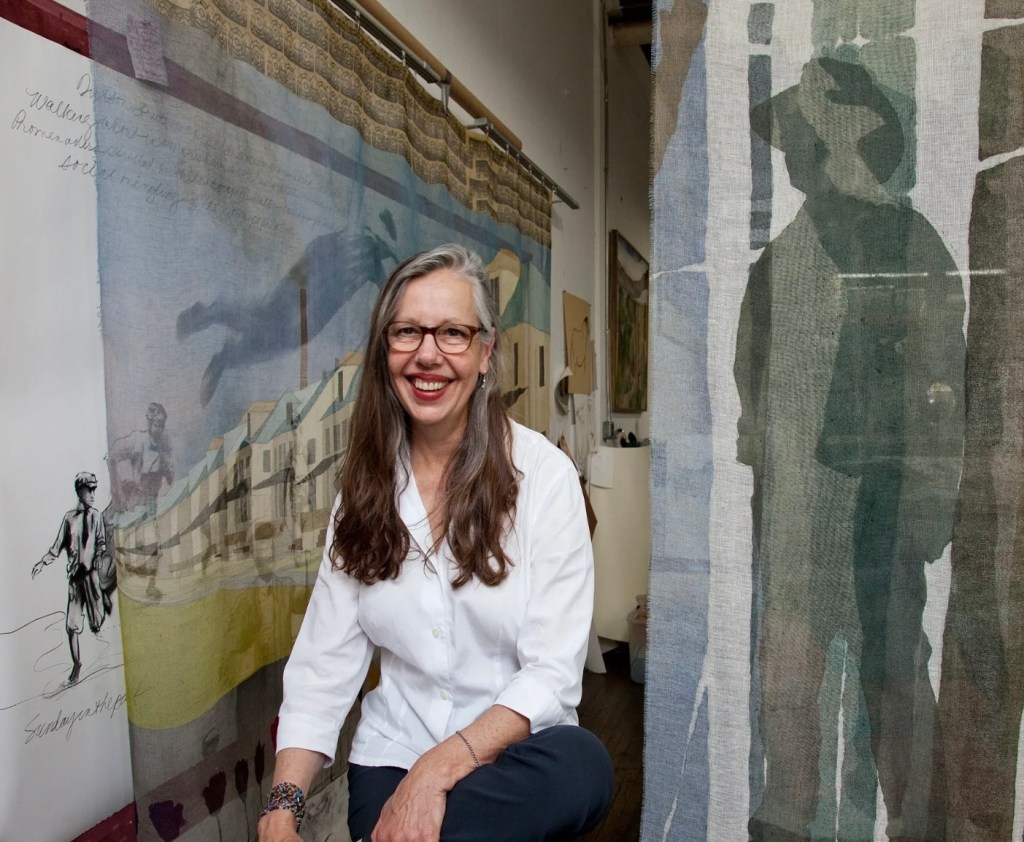
Deborah studied textile design at the Rhode Island School of Design and worked in the industry in NYC, LA and Europe.
As an artist she explores the condition of the American worker, creating interactive environments through painting, video and printed fabric scrims.
Deborah works as a design consultant and artist in Rhode Island, USA, in a former mill complex.
Deborah’s website can be found here
Deborah’s Artist’s Statement
I make artwork about work—the American workers, past and present, who are the bedrock of our diverse culture. Whether the subjects are mill workers, farmers, domestic servants, fishermen, or soldiers and veterans, whether they were American born, immigrants, or enslaved, the focus remains the same: to capture their spirit, tenacity, and hope.
My work is also about the passage of time, and the challenge of moving through changing circumstances without losing touch with our heritage. As a textile designer who saw mills close and the textile industry move offshore, I felt compelled to visually document this important American industry. The resulting exhibit was deeply personal, but the response to it confirmed my belief that the interaction between art and history can speak to people on many levels.
The artwork depicts the fabric of workers’ everyday lives—their daily routines, work environment, and restorative recreation.
I use multiple layers to create a sense of depth, space, time, and movement. Etched glass and translucent fabric panels, stenciled and silkscreened, cast shadows on paintings and drawings. As viewers move through the exhibits, the patterns and colors shift, animating the figures and transforming the light.
I create work for public spaces and for all the people who use them. Through my artwork, I aim to inspire conversation about our changing work force and economy, as well as the values that remain constant.
The work is also designed to evoke a personal, private response. Storytelling is central, but the tales are suggested rather than detailed. I believe this ambiguity allows people to connect with the work on a deeply personal level. Some people get a sense of stepping back in time to inhabit a distant moment, other see the ghosts of what was. For some, the work evokes family stories and a sense of connection to their heritage. It’s my hope that others will see the past as prologue, and find inspiration to go forward with hope and determination.
 Parallel Threads - Entangled Ends