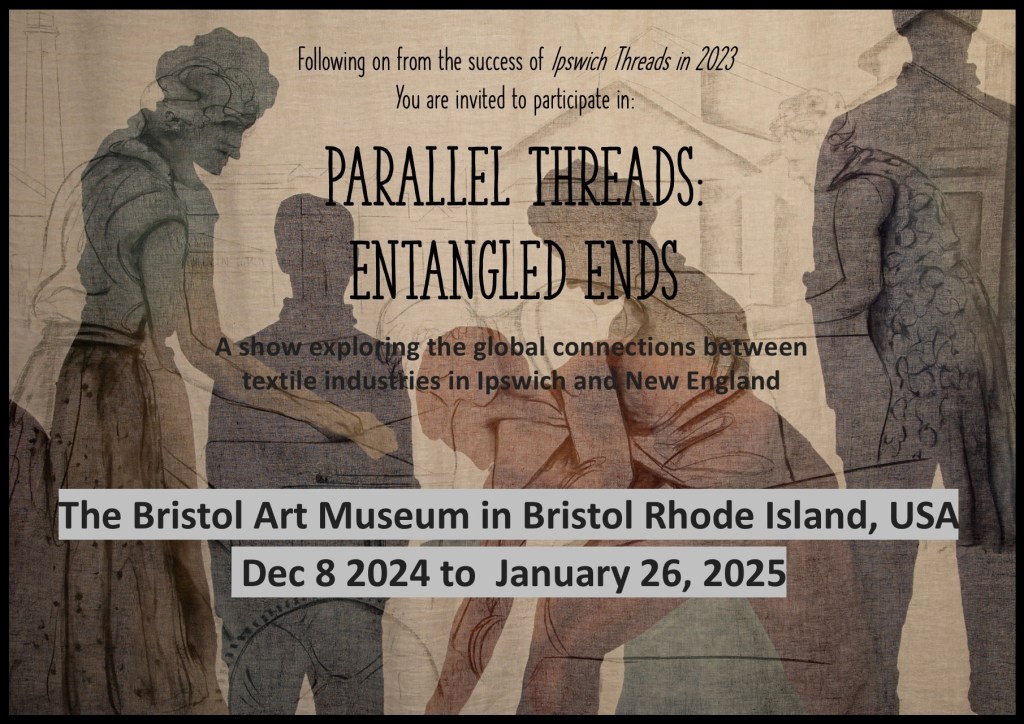
Parallel Threads is happening at …
Bristol Art Museum, Rhode Island, USA
Textile Mill closures were a global phenomenon. Since 2019 Deborah Baronas of Rhode Island, USA, and Dr Janis Hanley, Queensland, Australia, have been developing Parallel Threads, an immersive art installation. It explores the senescence of the textile industry in Ipswich, Australia, 1960s -1990s alongside the analogous demise of the textile industry in the United States.
Now, Parallel Threads – Entangled Ends is coming to Rhode Island. The project is a multidisciplinary exhibition featuring an art installation, individual artworks, archival research, video, sound, and panel discussions. A series of documentary films, lectures by Scholars and Filmmakers from Australia and the USA will be held throughout the run of the show.
This bi-national exhibition tells stories of loss for the workers and their communities and the impact of that loss on local culture and economies.
The themes explored are:
- the parallel timelines between Australia and the USA;
- workers’ experiences;
- mill closures and their impact on you and your community;
- adaption and renewal beyond the closures.
Participants:
- Former textile designers and mill workers who have experienced the loss of the industry.
- Artists and community members from Ipswich, Australia
- Queensland artists with a strong connection to the state’s textile manufacturing industry.
- Industry leaders from present day textile companies
- Heritage scholars and textile historians
- Filmakers
- Singer/songwriters/performers
Note: Australian artists may participate by sending actual works, or via digital recordings. See Guidelines for Australian artists here.
The entangled ends and new beginnings
Considering the global perspective from distant places, Ipswich and New England, raises the spectre of entanglements — the unseen influences operating at a distance.
The entangled endings of the industry in developed nations sowed the seeds of the phenomena of fast fashion and its damaging impact on the environment and textile workers.
Our goal is to focus on first-hand accounts of the rapid, wholesale mill closures and what is evolving since in these regions of the US and Australia.
The textile heritage legacy, is a reminder of good and bad of the past, and new ways forward.
Textiles are a basic need, and we are all reliant on its manufacture, wherever that occurs.
Our hope is that artistic representations of the industry story from the two distant locales of Ipswich and New England will inform understandings of the triumphs and failures in manufacturing, the local impacts, and help envisage renewed approaches for the future.
The exhibition is to be staged at the Bristol Art Museum in December 2024 through January 2025.
Interested in participating? Contact us to find out more here.
Ipswich Threads origins
Last year Deborah worked with artists and community members in Ipswich, creating an exhibition based on Janis’s doctoral research on the region’s textile heritage. Through contemporary art-making and interpretation of archival materials, participants explored the many facets of the heritage of textile production in their community.
The exhibition also addressed the relationship between the historical significance and contemporary uses of these mill buildings, to encourage heightened awareness of the importance of these mill structures and the spirits of the workers within them.
This was funded by a Regional Arts Development Fund Grant provided by the City of Ipswich and the Queensland government.
Bios
Dr. Janis Hanley, Griffith University: Janis’s work focuses on what heritage creates – and the voices not usually heard. Her doctoral research explored Queensland’s woolen textile industry, interviewing former workers about their mill experiences and the impacts of mill closures on the regional city of Ipswich.
Deborah Baronas
Deborah’s artwork explores the lives of workers who are the bedrock of our culture. Recording their stories, she visually shares them through immersive sculptural installations that capture their spirit, tenacity, and hope.
She also addresses systemic societal afflictions such as the opioid crisis and slavery along with a focus on heritage and the challenge of moving through changing circumstances without losing touch with our past,
Deborah’s previous mill exhibitions
In 2009, through grants from both RISCA and RICH Deborah created The Mill Project a visual study of the history of the textile industry in the northeast. The project focused on the workers, mostly immigrants, and their plight.
The Mill Project evolved into Flowers in the Factory which brought to life the ways in which mill workers coped with their difficult circumstances, their resolve to make a better life despite the hardships inherent in the industry and how they softened the harshness of the workplace.
 Parallel Threads - Entangled Ends