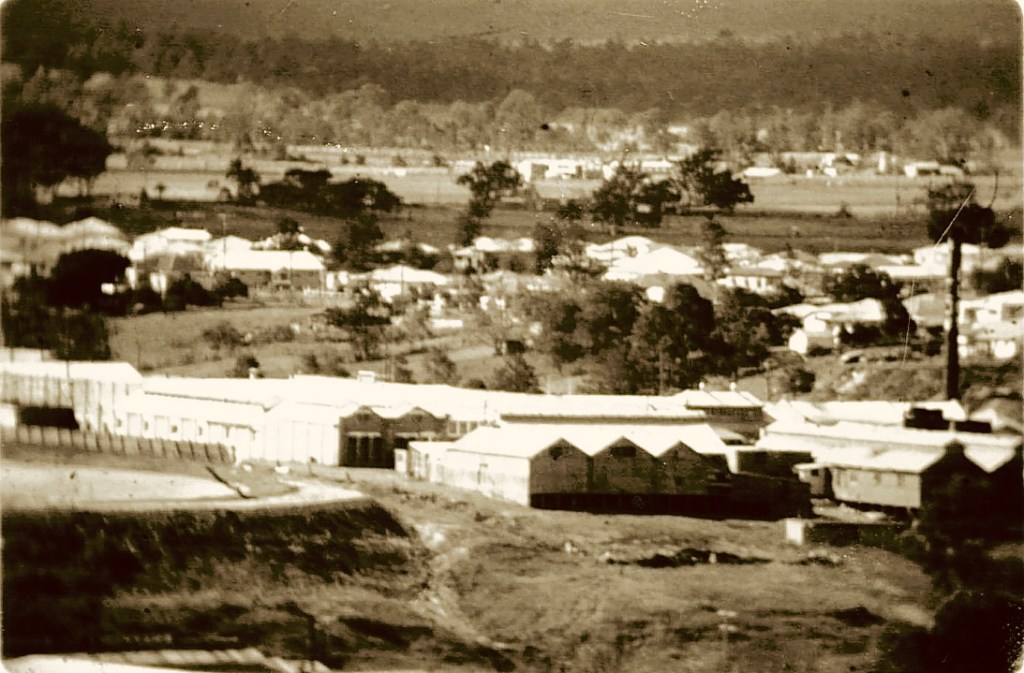
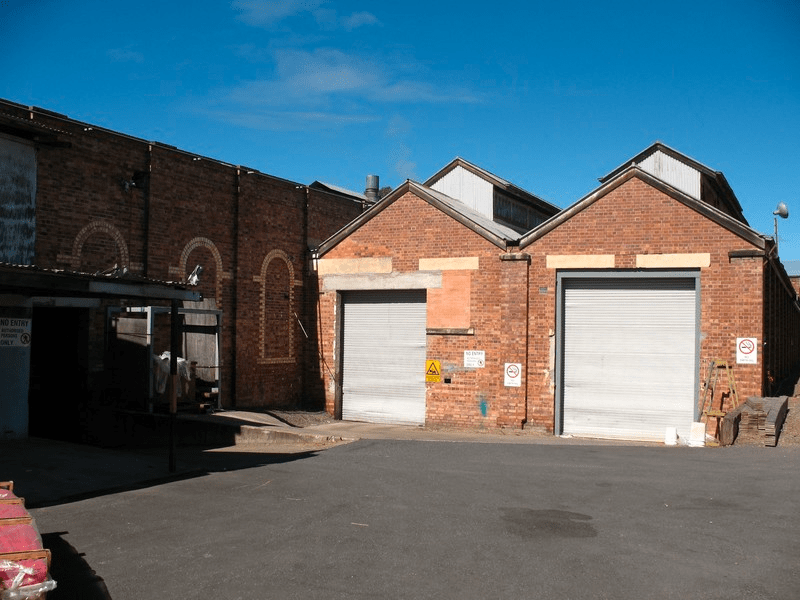
Image from the heritage listing shows the western side of the mill – formerly the mending room.
A good place for an overview of the North Ipsach mill, its significance and history at the tile of listing can be found here.
Further research since its listing in 2008, has revealed more details of its history, but it is good place to start.
Significance Statement
Criterion A: The place is important in demonstrating the evolution or pattern of Queensland’s history.
As the first woollen mill in Queensland, and an early example of large scale manufacturing, the mill played an important role in the development of the Queensland textile industry and is important in illustrating early vertical integration for the sheep industry in Queensland.
The textile industry was traditionally a major employer of women and The Queensland Woollen Manufacturing Company continued this tradition as it was the largest employer of women in Ipswich in the late nineteenth and early twentieth centuries.
The mill’s placement in Ipswich demonstrates the importance of Ipswich as a trading centre, receiving raw wool from the Darling Downs and passing the manufactured product on to Brisbane for distribution.
As a producer of uniform fabric and blankets for the armed forces in both the First and Second World Wars, The Queensland Woollen Manufacturing Company made an important contribution to Australia’s war effort. It has also been important as a supplier of Railway and Police uniforms.
Criterion B: The place demonstrates rare, uncommon or endangered aspects of Queensland’s cultural heritage.
The practice of woollen manufacturing in major textile centres such as Northern England was to have key processes carried out in separate manufactories. The Queensland Woollen Manufacturing Company is the first manufactory of its type in Queensland which processed the fibre from raw wool to textiles and garments.
The Queensland Woollen Manufacturing Company is rare as it was the first woollen mill in Queensland.
Criterion D: The place is important in demonstrating the principal characteristics of a particular class of cultural places.
The Queensland Woollen Manufacturing Company is important as an early and substantially intact example of a woollen mill in Queensland. The mill is sitting on the bank of a river for both transport and water for steam driven machinery, and its layout provides evidence of its operations. Within the mill are components that allow the reading of the hierarchical movement that occurred within the plant; the large steam engine room with furnace, the wool grading room, the scouring, drying and dying room, the large open halls in which the carding machines, spinning mules, weaving looms, shaving machines were once held, the sewing area and storage rooms all follow a purpose designed floor plan that was not changed for the duration of the woollen mill’s existence.
The mill is an example of the work by prominent Ipswich architect George Brockwell Gill. Other notable work by Gill includes the Ipswich Girls’ Grammar School (QHR 600565), the Ipswich Technical College, the Ipswich Club (QHR 600581), the Hotel Metropole (QHR 600567), and ‘Brynhyfryd’ House.
Criterion E: The place is important because of its aesthetic significance.
Built on the elevated corner of a bend in the Bremer River the large brick exterior walls of the mill are a landmark in North Ipswich and have been since the brick structure was built in 1890. Due to the mill’s distinctive size, setting and compositional qualities it is clearly visible from many areas around Ipswich.

 Parallel Threads - Entangled Ends
Leave a comment